Renovating a Home in Mallorca in 2026: Costs, Permits and How to Find the Right Company
 News
News
A practical guide for owners and buyers, from what a renovation actually costs on the island to the paperwork nobody warns you about.
Buying or owning a home on Mallorca and renovating it almost always go together. A finca that has stood for a century, a Palma flat that needs the kitchen moved, a villa in Santa Ponsa on its second or third refit, they all reach the same question sooner or later: what will the work cost, and who do you trust to do it? Neither answer is as simple as it looks, and both are where people lose money. Here is what the island market looks like in 2026, and how to approach it without guessing.
Visit mallorcarenovation.com for free qoutes from local companies.
What a renovation costs on Mallorca
There is no single figure, and anyone who gives you one without seeing the property is guessing. But there are ranges, and they move with the level of work more than with anything else. These are indicative 2026 island market rates, not a quote.
| Level of work | What it covers | Indicative €/m² |
|---|---|---|
| Light / cosmetic | Surfaces, paint, fittings; services untouched | €300–600/m² |
| Medium | Kitchen, bathrooms and floors, part of the services | €650–950/m² |
| Complete / integral | Stripped back, electrics and plumbing renewed | €1,000–1,800/m² |
| High-end / luxury | Designed, premium materials, bespoke joinery, home automation | €1,800–3,500+/m² |
Room by room, a standard bathroom refit is typically €4,000–9,000, and a larger or high-end bathroom €10,000–20,000 or more. A standard kitchen runs €8,000–18,000, and a premium or bespoke one with a stone worktop €25,000–60,000 or more.
One thing that surprises newcomers: the island itself adds cost. Materials are shipped over, skilled trades are in high demand, and access to some plots is difficult, so expect roughly a 10–20% premium over mainland Spain, more in peak season. If you want the full breakdown by property type and size, there is a detailed renovation cost guide for Mallorca that lays it out.
The four things that actually move the price
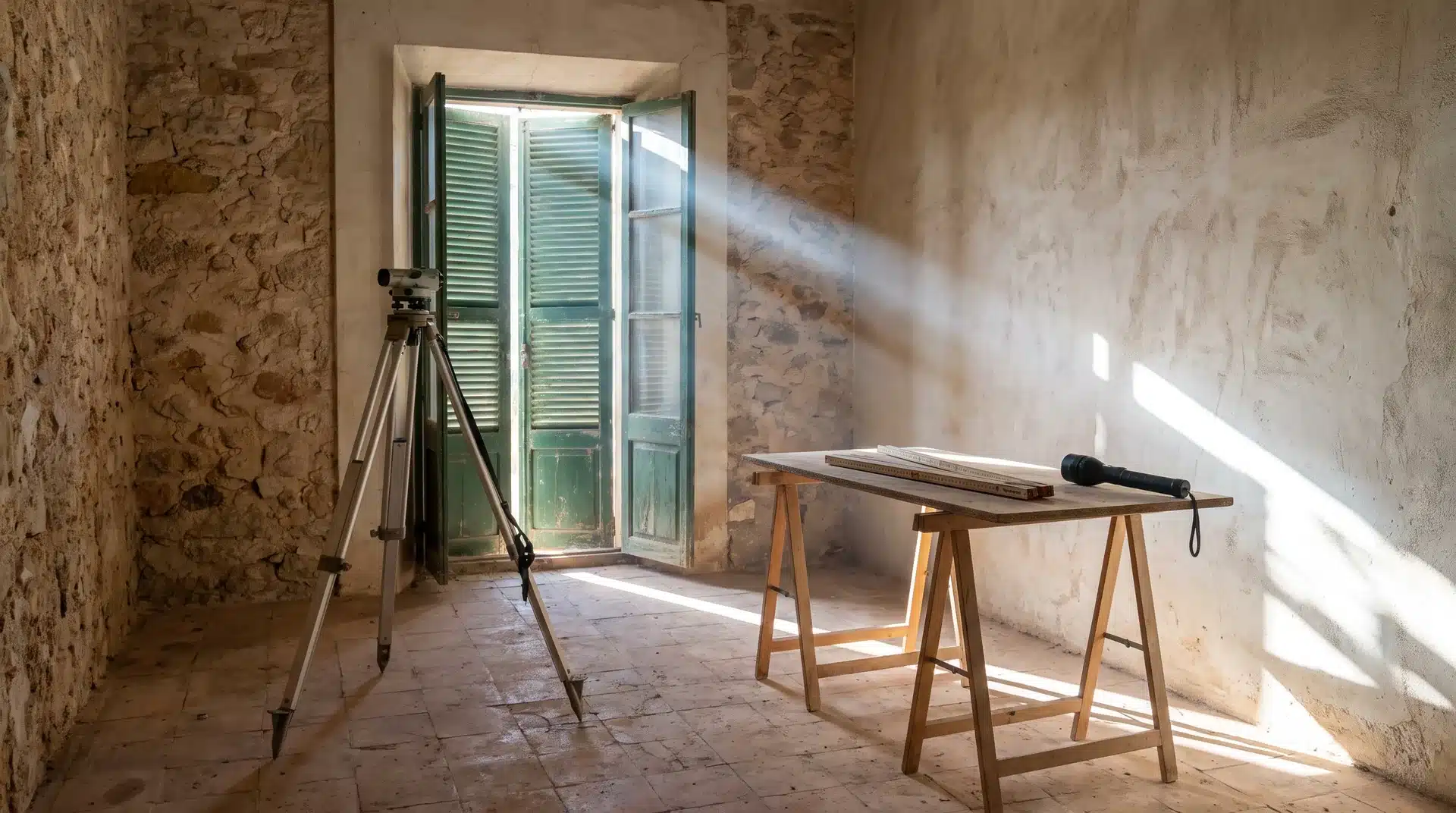
Most people worry about the tiles. The tiles barely matter. Four things move the number far more:
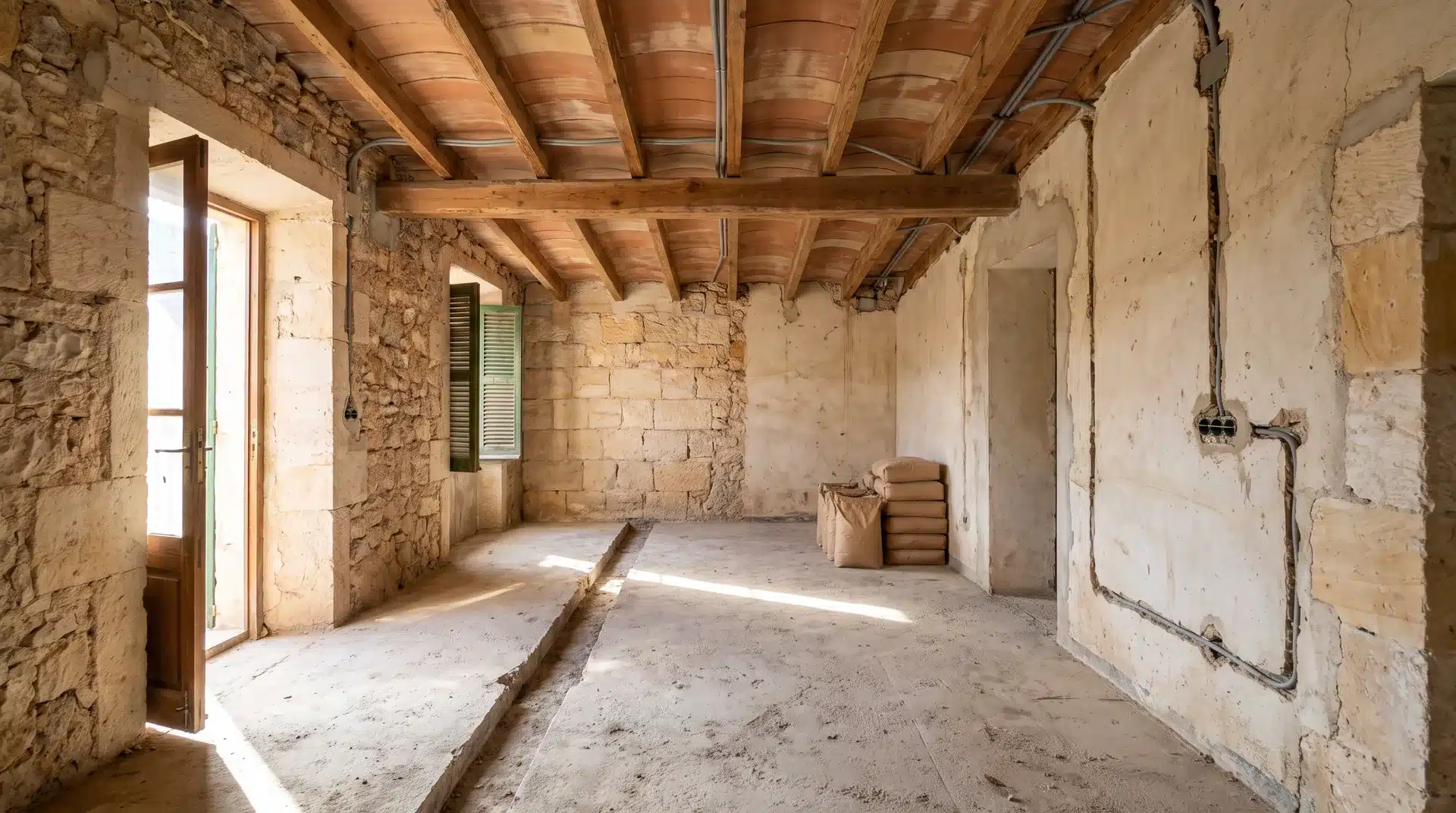
- Whether the electrics and plumbing are being replaced. This is the step change. Renewing them means opening walls, floors and ceilings throughout, so finishes come off in every room, not just the ones you are changing.
- What the structure turns out to be. Removing a wall is a different job depending on whether it is holding up the floor above, and on older property that is not reliably visible until work starts.
- How the property is reached. A plot a lorry cannot enter, or where material arrives by crane, is charged on every delivery rather than once.
- The specification, which matters less than people expect. A better tile changes the total by far less than any of the three above.
Permits and licences: start here, not later
On Mallorca the paperwork decides your start date more often than the builder does. In broad terms, a like-for-like refit (same layout, no structural or facade changes) is usually a comunicación de obra menor, a minor-works notice. The moment you move services, take down walls, touch the facade or change the footprint, you are into a major-works licence, which takes longer and needs a technical team. In protected or historic areas, and for listed fincas, the rules are stricter again.
The practical lesson: ask about permits before you fall in love with a plan. A local company that already works in your municipality will know which licence applies and how long the town hall currently takes, and that timeline, not the building work, is usually what pushes a project back.
How to find and compare companies (the hard part)
Finding a renovation company on Mallorca is genuinely difficult if you do not already have a name. Recommendations are gold but scarce, directories are full of listings that pay to be there, and cold-calling companies means you explain the whole project again every time and get quotes built on different assumptions.
The cleaner approach is to describe the property and the work once and let several companies price the same brief. That is exactly what a free comparison service like Mallorca Renovation does: you set out the job, it goes to vetted renovation and building companies that take on that kind of project in your area, and they quote you directly. You compare the numbers, and any agreement is between you and the company you choose. Comparing costs nothing and commits you to nothing, which is the right way to start when you do not yet have a trusted contact.
Making two quotes comparable
Once the quotes come in, the cheapest is very often the one that excluded the most. Two prices are only comparable if they answer the same questions. Before you compare, check that each quote states:
- Whether the electrical installation is included or assumed to stay.
- Whether structural work has been allowed for, or the company was never told about it.
- Whether making good after the services is priced, or the quote stops at first fix.
- What access it assumes, and whether crane or hand-carrying time is in there.
- Whether the technical team and permissions are included or left with you.
- Whether there is a stated contingency, or it is hidden in the rates.
The single most useful question you can ask any company is simply: what have you excluded? If you want a figure for your own property, you can describe it once and get comparable quotes rather than chasing companies one at a time.
The short version
Renovating on Mallorca is very doable and often adds real value, but it rewards preparation. Know the rough €/m² range for the level of work you want, sort the permit question early, and get several companies to price the same written brief so the numbers actually mean something. Do that, and the island’s biggest renovation risk, paying too much because you could not compare, mostly goes away.